


When we started the program of reintroduction of lynxes in north-western Poland, we knew that one of the threats to these cats could be mange.
We knew this disease and we were aware that if left untreated, it could lead to the death of the animal.
However, we did not expect that mange would become one of the biggest challenges for the lynx population restored by the West Pomeranian Nature Society.
So far, we have identified mange in 26 lynxes under monitoring. 20 of them were saved, but 6 animals died. These are only cases that we know about – the actual number could have been higher, because not all released lynxes are covered by telemetry monitoring.
Mange is a parasitic disease caused by the microscopic mite Sarcoptes scabiei. The parasite drills tunnels in the epidermis, where it lays eggs. The body reacts with severe inflammation and extremely intense itching. The animal constantly scratches, gnaws at the fur and damages the skin, which leads to extensive wounds and promotes secondary bacterial and fungal infections.
As the disease progresses, the lynx loses its fur, which is its natural thermal insulation. A weakened animal spends more and more energy on fighting the parasite and maintaining proper body temperature, while having more and more difficulty in hunting. As a result, the body is destroyed, dehydrated, emaciated and gradually loses strength. Without treatment, mange in lynxes ends in death.
In our project, along with road collisions, mange turned out to be one of the most serious causes of mortality of reintroduced lynxes. This shows that the protection of this species does not end when the animal is released into the wild. Telemetry monitoring, quick detection of disturbing changes and the ability to intervene before it is too late are equally important.
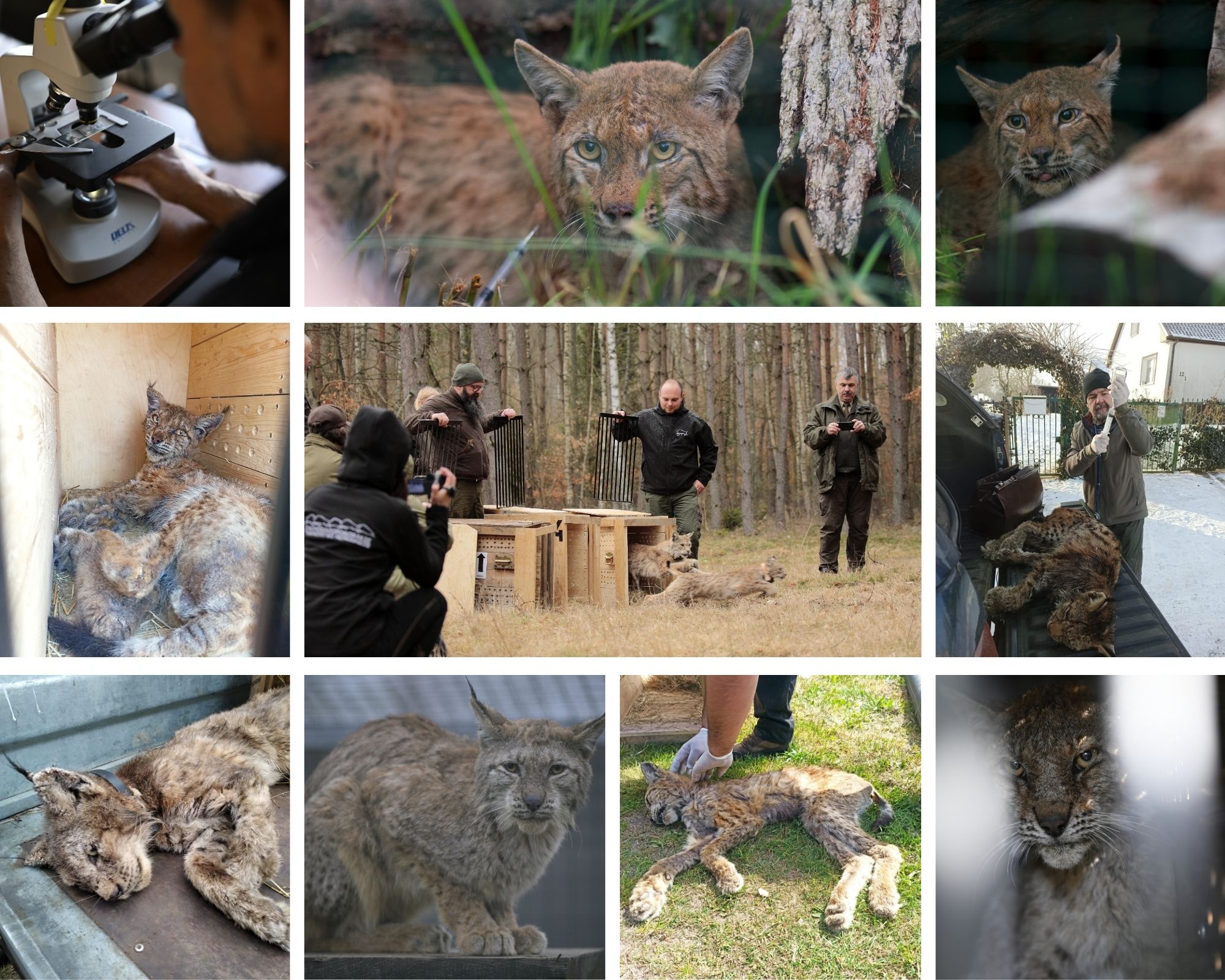
Most often, the source of infection are other wild mammals, primarily foxes, raccoons and raccoon dogs, in which mange is common. Lynx can become infected during contact with an infected animal, but also during hunting or after staying in places where a sick individual has stayed. The parasite can also survive for a short time outside the host’s body, so infection does not always have to occur as a result of direct contact.
Although the lynx is a specialized predator that hunts mainly roe deer, it also feeds on smaller mammals such as foxes or raccoon dogs. Any contact with infected prey increases the risk of transmitting the parasite. In an environment where mange is common in other species, the threat to lynxes increases significantly.
Archive of the West Pomeranian Nature Society
__________________________
The activities are carried out by the West Pomeranian Nature Society as part of the LIFE22-NAT-PL-LIFE LYNX PL LT DE Project „Expanding the range of lynx populations in northern Poland”.
Funded by the EU. The views and opinions expressed are those of the author or authors only and do not necessarily reflect the views and opinions of the European Union or the European Climate, Environment and Infrastructure Executive Agency (CINEA). Neither the European Union nor CINEA are responsible for them. Co-financed by the National Fund for Environmental Protection and Water Management and the WWF Poland Foundation.
The project partners are:
West Pomeranian Nature Society
WWF Poland,
Spychowo Forest District,
State Forests
Ekosistemų apsaugos centras
Rewilding Oder Delta
#LIFEprogramme
#LIFEproject
#LIFEAmplifier

 Polish
  English