


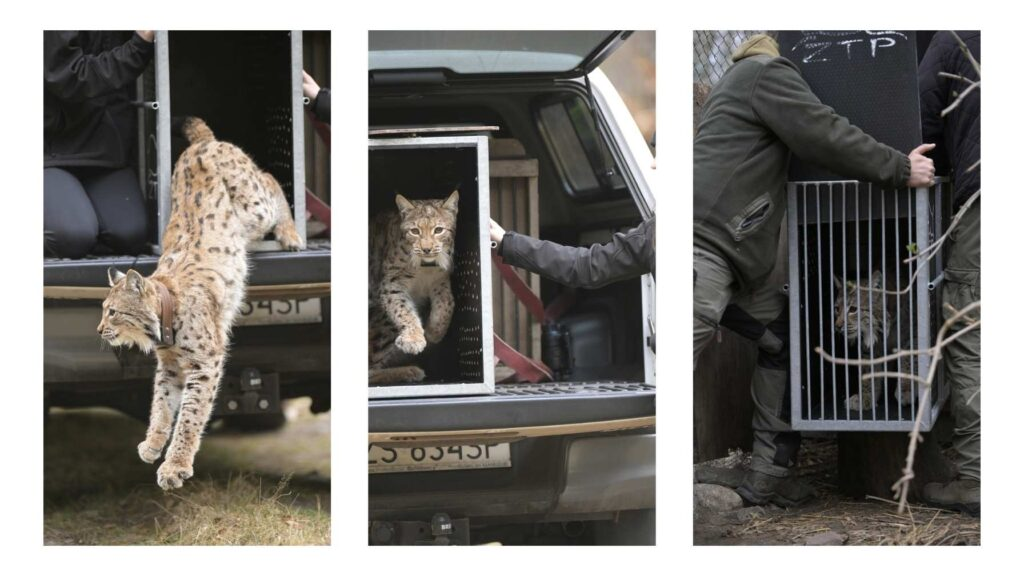
Lupek is one of over 110 lynxes released as part of the reintroduction of lynxes by the West Pomeranian Nature Society. We brought him from Germany in May 2023. From the very beginning, he gave us strong impressions: just before being caught in the wildpark, Lupek made an attempt to escape! He managed to jump over the fence, escape from the enclosure and run through the entire center. He stopped only in front of the enclosure with wolves, which clearly interested him. He stared at them long enough to be caught. That’s how he got his name. Lupek, a diminutive of „lupus” – the Latin name for wolf – Canis lupus.
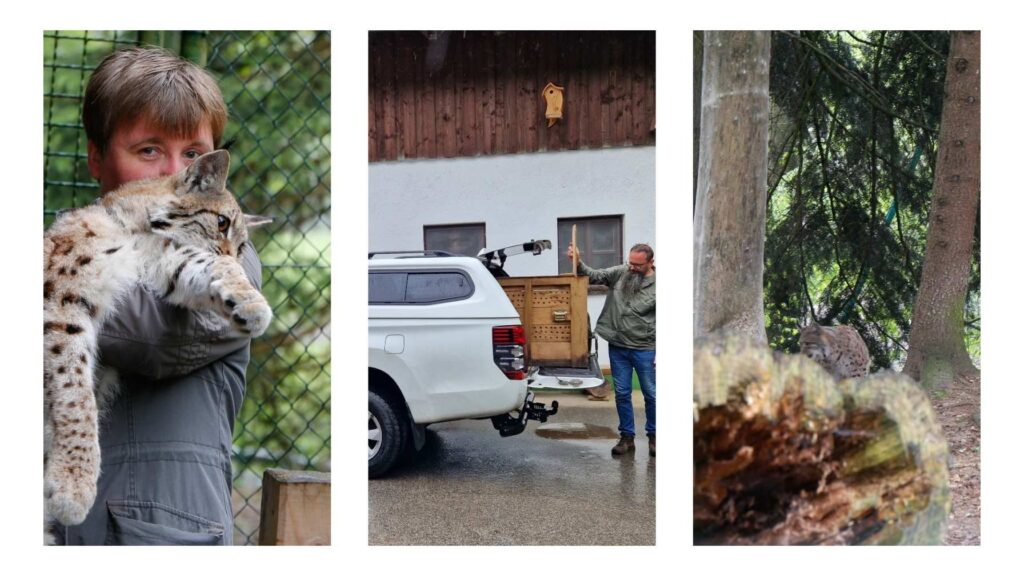
Germany 2023 – preparation of Lupek for transport to Poland
After a period of adaptation in the Dzika Zagroda, he was released into the wild. This is usually – as in most such stories – that visual contact ends. But thanks to telemetry, we began to observe his fate. Lupek began an extremely adventurous life. To our surprise, it turned out that he had taken a journey north, all the way to the Baltic Sea! Have you ever met a lynx on the beach? Keep your eyes open, because Lupek proved that it is possible! And in addition, he went there twice. The first time in the spring of 2024 – he wandered to Lake Kopań and reached Jarosławiec. For safety reasons, he was then caught by us and transported inland. But Lupek apparently liked walks by the sea. In the autumn, he undertook another hike to the Baltic Sea – this time to the area of the Słowiński National Park. Due to the fact that he approached an area intensively used by human – he was once again caught.
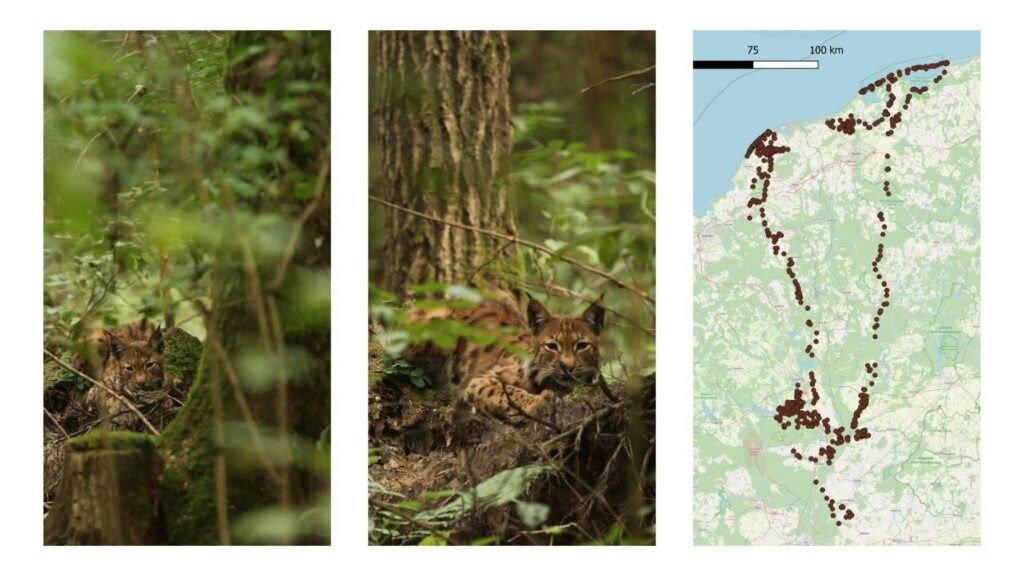
Lupek’s first control in the field and a map of his migrations to the sea
For years, the lynx in Poland remained a poorly recognized species on a population scale. Informations about its survival, migrations or causes of mortality were scattered. It was only the development of telemetry – implemented on a large scale by the West Pomeranian Nature Society – that began to fill this gap.
What is the collected data? It might seem that telemetry is just a VHF signal received by an antenna and a moving GPS point on the map. In reality – the lynx that is most often not seen. Between technology and nature – there are also people: people who conduct observations in the field and interpret the data set from behind their desks. Sometimes it is the skilful assessment of the situation and the analysis of data in the application – that saves the life of an animal.
Today, nearly 50 collars are active. Each of them is a sequence of locations that can be translated into specific data about the animal. It is from these data that we know that:
– the most difficult period is the first winter after release,
– survival rate during this time drops to about 50%,
– young lynxes undertake distant and risky migrations, – some threats – diseases, injuries – remain invisible without direct control.
Therefore, monitoring does not end with tracking points on the map. It also includes selective field checks. They are carried out to check something that is not visible in the data: the condition of the animal.
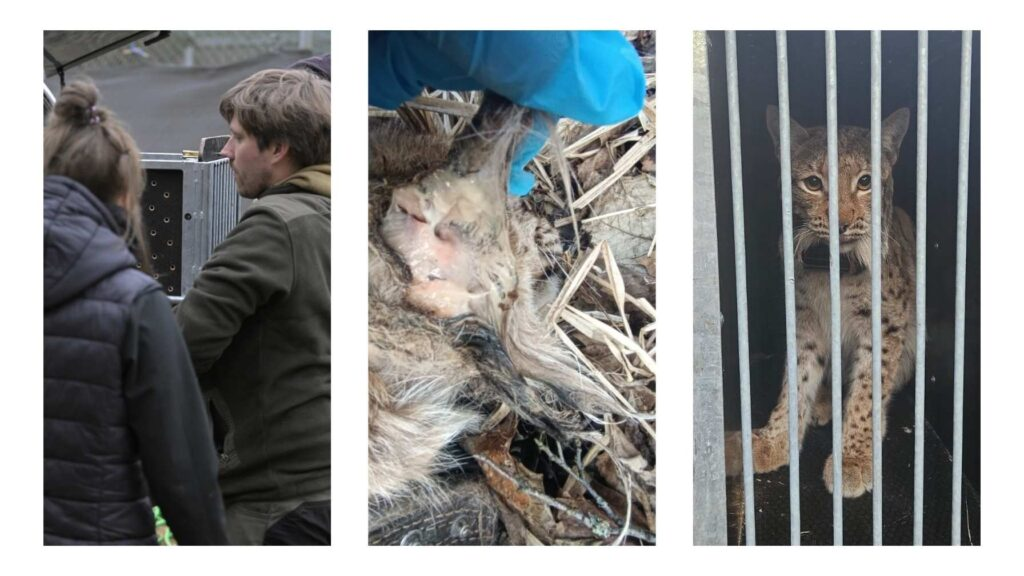
Catching Lupek – March 2026, in the middle photo a wound making it difficult for the animal to hunt and eat
Lupek was taken to our Lynx Rehabilitation Center in Dzika Zagroda in Jabłonowo, under the care of a veterinarian. He underwent a procedure of cleaning and suturing a deep wound, received antibiotics and anti-mange drugs. Before release, follow-up tests were carried out. After a month, Lupek was released – in the place from which we caught him – in good condition, able to continue functioning in the wild.
It is a story written by one lynx, but built exactly from the same elements as several dozen others: a signal, an analysis, a decision, an intervention – or its absence, if it is not needed. Without the collar, this scenario would have had a different – tragic ending
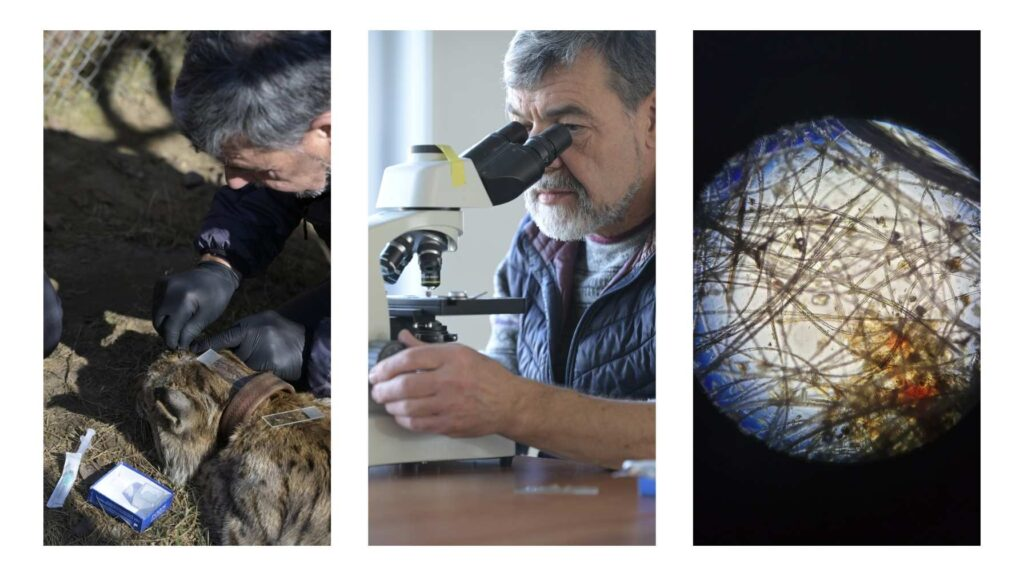
Tests qualifying Lupek for re-release
Telemetry is not an add-on to the project. It is its core. It is thanks to it that the reintroduction does not end when the cage is opened and the animal is released. For ZTP employees, it goes to the stage of monitoring, analysis and – if necessary – intervention. It is also a tool that takes the scale of our knowledge about the lynx to a completely different level than, for example, camera traps. Until recently, single observations of lynx were an event. Today, we have continuity of data: trajectories, the pace of exploration, habitat choices, reactions to human pressure. We know when the lynx hunted its prey. We know where and when the female lynx gave a birth. We also know when the signal becomes alarming and the lynx needs help, because you can tell from the readings that it has contracted mange.
Lupek is one of many. But it is living proof of how much we owe to one telemetry collar. Its history shows well what modern protection of large predators is in practice: a combination of biology, technology and decisions made on the basis of data, not guesses and random encounters. The West Pomeranian Nature Society analyses the incoming data every day – if necessary, employees are ready to take action.
The activities are carried out by the West Pomeranian Nature Society as part of the Project LIFE22-NAT-PL-LIFE LYNX PL LT DE „Expanding the range of lynx populations in northern Poland”.
Funded by the EU. The views and opinions expressed are those of the author or authors only and do not necessarily reflect the views and opinions of the European Union or the European Climate, Environment and Infrastructure Executive Agency (CINEA). Neither the European Union nor CINEA are responsible for them. Co-financed by the National Fund for Environmental Protection and Water Management and the WWF Poland Foundation.
The project partners are: West Pomeranian Nature SocietyWWF Poland, Spychowo Forest District, State Forests
Ekosistemų apsaugos centras
Rewilding Oder Delta
#LIFEprogramme
#LIFEproject
#LIFEAmplifier

 English
  Polish